Every organization that's moved past their first AI proof-of-concept hits the same wall: the POC worked, but scaling it means answering questions nobody thought about during the demo. Where do prompts get versioned? Who controls which teams can access which models? How do you enforce guardrails consistently across ten different AI features? What happens when the compliance team asks for an audit trail?
Without an architectural standard, each team solves these problems independently — and differently. You end up with fragmented AI stacks, inconsistent security postures, ungoverned model usage, and cost sprawl that nobody can attribute to specific workloads. It's the same pattern we saw in early cloud adoption before Landing Zones and Control Tower brought order to multi-account sprawl.
AI solutions need that same standardization layer. After building production AI systems across healthcare, aviation, financial services, and professional services, we've found that Amazon Bedrock provides it — not as a single feature, but as a platform architecture that gives organizations consistent patterns for model access, security, governance, and operations.
Here's what that looks like in practice.
The Problem: Solving Infrastructure Before the Use Case
A pattern we see repeatedly across organizations adopting AI: teams spend the first 4–6 weeks of any project building infrastructure that has nothing to do with the actual problem they're trying to solve.
Model hosting. Token management. API key rotation. Rate limiting. Prompt versioning. Logging that doesn't accidentally capture PII. IAM boundaries between the AI layer and the rest of the application. Retry logic. Failover. Cost tracking at the workload level.
None of this differentiates the solution. But all of it has to exist before anything ships to production. And when every team builds it independently, you get five different approaches to the same undifferentiated problems — each with its own security gaps, operational blind spots, and maintenance burden.
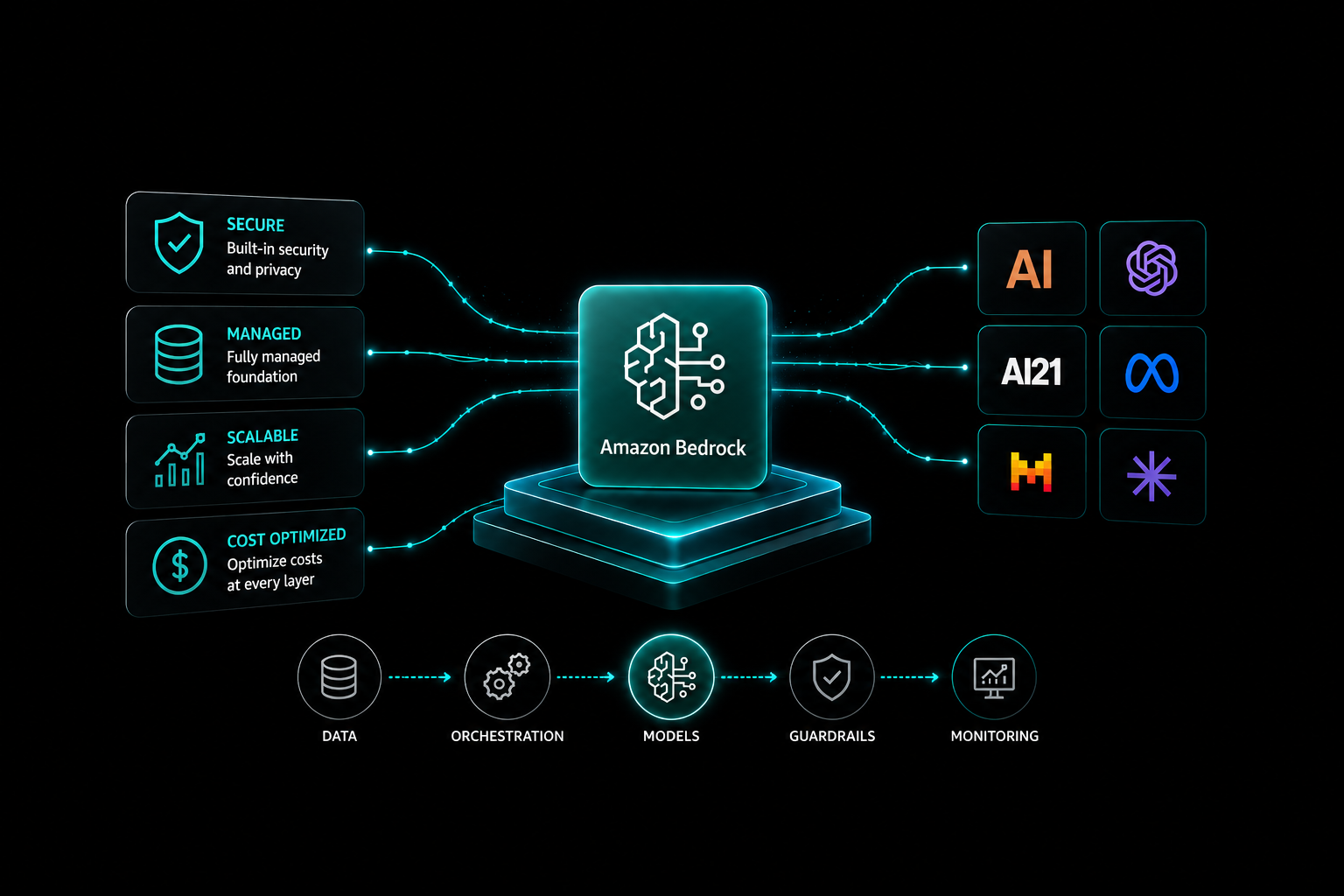
Bedrock standardizes this layer. The models are managed. The infrastructure is invisible. The security model inherits from your existing AWS IAM posture. The compliance story is already documented. Teams start at the use case, not at the plumbing — and they all start from the same foundation.
Model Choice Without Model Lock-In
One of the most practical benefits of Bedrock is model flexibility without architectural rework. Today we build most solutions on Anthropic's Claude — it's our primary model for reasoning-heavy workloads, and its instruction-following precision is best-in-class for the enterprise use cases we see most.
But Bedrock gives us options:
- Claude (Sonnet, Opus, Haiku) — our default for complex reasoning, document analysis, agentic workflows, and any task where accuracy and safety matter more than raw speed
- Meta Llama — when customers need fine-tuning flexibility or have specific open-weight requirements
- Mistral — for multilingual workloads or cost-sensitive high-volume inference where a smaller capable model outperforms a larger expensive one
- Amazon Titan — for embeddings, image generation, and cases where customers want to stay fully within the AWS ecosystem
Swapping models is a configuration change, not an architecture change. We've had engagements where we started with one model during prototyping the switched to another for production based on latency, cost, or accuracy benchmarks — without rewriting a single pipeline component.
That's the right kind of flexibility: choice within a unified platform, not an abstraction layer that sacrifices capability for portability.
Security That Doesn't Require a Separate Workstream
In regulated industries — healthcare, financial services, government — the security and compliance conversation around AI can kill a project before it starts. "Where does our data go?" "Who can see our prompts?" "Does the model train on our inputs?" "How do we audit this?"
Bedrock answers all of these by default:
- No data retention — prompts and completions are not stored by AWS or the model provider. Your data doesn't leave your environment.
- VPC endpoints — model inference stays within your VPC. No public internet traversal.
- IAM-native access control — who can invoke which model, on which workload, is governed by the same IAM policies that control the rest of your AWS environment.
- KMS encryption — data at rest and in transit, using your own keys.
- CloudTrail logging — every model invocation is auditable.
- HIPAA eligibility — Bedrock is covered under AWS's Business Associate Agreement.
For our healthcare customers, this is the difference between a 6-month security review and a 2-week addendum to their existing AWS BAA. We've shipped HIPAA-compliant AI solutions on Bedrock in timeframes that would have been impossible with a standalone model provider requiring its own compliance certification.
Knowledge Bases and RAG — Done Right
Retrieval-Augmented Generation is where most production AI systems live. The model alone doesn't know your business. You need to connect it to your documents, your data, your institutional knowledge.
Bedrock Knowledge Bases handle this end-to-end:
- Automatic document ingestion from S3 (PDFs, Word docs, HTML, markdown)
- Managed embeddings and vector storage (OpenSearch Serverless or Aurora pgvector under the hood)
- Chunking strategies you can configure without writing custom ETL
- Automatic re-indexing when source documents change
- Citation tracking so the model tells you which document informed its answer
We've deployed this pattern for customers across multiple industries:
Healthcare — Clinical protocol assistants that surface relevant guidelines from thousands of pages of medical documentation, with citations back to the source document and section.
Professional services — Internal knowledge systems that let employees query policy manuals, past proposals, and project documentation in natural language instead of keyword search.
Aviation — Maintenance plan optimization tools that cross-reference regulatory requirements with manufacturer bulletins and fleet-specific history.
In each case, the RAG infrastructure was operational in days, not months. The engineering effort went into prompt engineering, evaluation, and domain-specific tuning — the parts that actually determine whether the system is useful.
Agents and Agentic Workflows
The next evolution beyond RAG is agentic AI — systems that don't just answer questions but take multi-step actions: query databases, call APIs, make decisions, and execute workflows with minimal human intervention.
Bedrock Agents provide the orchestration layer for this:
- Tool use — define tools (Lambda functions, API calls, database queries) that the agent can invoke
- Multi-step reasoning — the agent plans its approach, executes steps, evaluates results, and adjusts
- Session memory — maintain context across a conversation or workflow
- Integration with Knowledge Bases — agents can query your RAG system as one of their tools
We're building agentic systems for customers that automate processes which previously required manual human coordination across multiple systems. The key insight: agents aren't magic. They require careful tool design, explicit guardrails, and thorough evaluation. Bedrock gives you the orchestration; we bring the methodology for making agents reliable enough for production.
Guardrails — The Feature Most Teams Forget Until It's Too Late
Every AI system in production needs boundaries. What topics should it refuse to discuss? What PII should it never surface? What claims should it never make? How do you prevent prompt injection?
Bedrock Guardrails let you define these policies declaratively:
- Topic denial — block specific subjects the model shouldn't engage with
- Content filtering — automatically flag or block harmful, inappropriate, or off-brand content
- PII redaction — detect and mask sensitive information in both inputs and outputs
- Grounding checks — verify that responses are supported by the source documents (reducing hallucination)
- Word/phrase filters — block specific terminology, competitor names, or regulated claims
These aren't afterthoughts bolted on post-launch. In our engagements, guardrail design happens during architecture — before the first prompt is written. It's dramatically easier to build safety in from the start than to retrofit it after users have already experienced the system without boundaries.
Cost Management in Practice
AI workloads can get expensive fast if you're not intentional about model selection, prompt design, and throughput management. Bedrock gives you the knobs:
- On-demand pricing — pay per token, no commitment, good for development and variable workloads
- Provisioned Throughput — reserved capacity at lower per-token cost for predictable production workloads
- Model selection by task — use Haiku for classification and routing, Sonnet for generation, Opus only for complex reasoning. Match the model to the task complexity.
- Prompt caching — reduce costs on repeated context by caching system prompts
- CloudWatch metrics — track token usage, latency, and costs per workload, per customer, per environment
We've helped customers reduce their AI inference costs by 40–60% simply by right-sizing model selection across their workflow stages. Not every step needs the most powerful model. Bedrock makes it easy to use a lightweight model for triage and routing, then invoke a more capable model only when the task demands it.
Best Practices From the Field
After building production AI systems on Bedrock across multiple industries, here's what we've learned matters most:
Start with evaluation, not deployment. Before you ship anything, define how you'll measure success. What does a good answer look like? What's the acceptable hallucination rate? What latency is tolerable? Build your eval framework first, then iterate toward it.
Design your prompt architecture like you'd design a database schema. System prompts, user prompts, tool descriptions, guardrail policies — these are the interface between your application and the model. Version them. Test them. Review changes like you'd review code.
Use the smallest model that meets your quality bar. Haiku is surprisingly capable for structured tasks (classification, extraction, summarization of short documents). Reserve Sonnet and Opus for work that actually requires their reasoning depth.
Build for observability from day one. Log inputs, outputs, latency, token counts, and guardrail triggers. When something goes wrong in production — and it will — you need to be able to trace the exact interaction that caused it.
Separate concerns in your agent architecture. Don't build one monolithic agent that does everything. Build specialized agents with specific tools and clear boundaries, orchestrated by a routing layer. This makes them testable, debuggable, and safe.
Plan for model upgrades. New model versions ship regularly. Your system should be able to swap model versions, run A/B tests, and roll back without downtime. Bedrock's model versioning makes this possible — but you need to design your evaluation pipeline to take advantage of it.
What Atayo Brings
Bedrock provides the standardized platform. What organizations still need is the expertise to implement that standard correctly — tailored to their industry, their data, and their operational maturity. That's where we come in:
- Use-case validation — not everything should be an AI problem. We help customers identify where AI delivers real ROI vs. where traditional automation is the better fit.
- Architecture design — RAG vs. fine-tuning vs. agents vs. simple prompting. The right pattern depends on the use case, data characteristics, and latency requirements.
- Prompt engineering and evaluation — systematic prompt development with automated evaluation pipelines, not ad-hoc iteration in a playground.
- Security and compliance integration — designing AI systems that fit within existing governance frameworks, not around them.
- Production operations — monitoring, alerting, cost optimization, and ongoing model evaluation as part of our managed services practice.
- Anthropic expertise — as a Claude Partner Network member and approved Anthropic reseller, we bring direct Anthropic alignment to every engagement.
Get Started
Whether you're establishing AI standards for your organization, scaling a prototype to production, or looking for a partner to implement Bedrock the right way from the start — Atayo brings the architecture expertise and production experience to make it work.
Talk to an Atayo AI architect about standardizing your AI architecture, or read about how we're putting these patterns to work in our case studies.
Tags
Atayo Group
AWS-certified cloud practitioners delivering end-to-end cloud solutions and services.
About Atayo →